Search

Conceptual Irregularities

The modern composer refuses to die – Edgar Varese

Category

family

Granddaddy

My mother’s father, Howard Barnes, was a man of the 20th century, in the modern sense. He was sophisticated and wore his erudition on his sleeve. He was a drama critic for the New York Herald Tribune, an alumnus of Yale and Oxford, a man about town and one heck of a piano player (at least to my three year old ears.)

He was also a drunk and a womanizer. But that is not what I remember. I remember sitting on his knee at the piano, banging the keyboard with him intoning, “Gently, gently”, at my ear. He was endlessly kind and patient with all of us and now that I see my friends with grandchildren, I begin to get it, but with him, I just took it for granted.

He and his third wife, Cassie, had an apartment in New York city on the upper east side of Manhattan. My memories of visiting him there are mostly smells and taste. I can taste the New York water in the little fridge in the tiny kitchenette. I can smell the florist down on the street, the cut flowers in the foyer of their building, the delicious aroma of bakeries with croissants and brioche.

He was elegant and handsome but not a smooth handsome. His face was lined and drawn, lived in, the crags dug both by the picks of experience and the storms of tobacco and drink. I like to think of him as a bourbon man, but I guess I don’t really know. I believe he smoked Camels, but it might have been Chesterfields like my dad. He also smoked a pipe. These smells sit with me to this day.

Cassie worked at Macy’s, one of the executives and a powerful working woman, back before it was a thing. The two of them were part of the Manhattan high society in the forties and fifties. They both had illustrious friends from their professional lives. My mother would tell the story of how they took her to the famed New York restaurant, 21, on her 21st birthday which they celebrated with Humphrey Bogart and Lauren Bacall.

Cassie and Granddaddy gave the best Christmas gifts. Once I got a clarinet and another year I got a microscope.

When he wasn’t reviewing plays and she wasn’t pushing fashion, they retired to their country house in New Hartford, Connecticut, Hickory. He had it built in the mid thirties on a beautiful side of a hill. It had a long driveway leading up to a landing between the house on the left and the meadow below. The house was simple, a long ranch with a big living room in front and the master bedroom behind it. The kitchen was on the other side of the stairs in the entryway. Upstairs were 3 bedrooms where we stayed. There was a long hall going down the middle of the second floor leading to my parents’ room. The hall was kind of creepy and mysterious. It was dark and it echoed. It was claustrophobic yet big at the same time.
Outside, to the left of the house and up a little hill was a cement swimming pool built on a rock ledge and fed by a cold spring. It’s hard to say how big it was but it might have been as small as ten by ten. But it was perfect for kids. We spent a lot of time in the pool.

In the back of the house, out behind the kitchen, was a big cubical rock. It was too big for us to climb to the top of easily and we spent way too much time trying to figure out how to get up there.

At the end of the parking area, there was a shed. This was the domain of Mr Hecht, Granddaddy’s all around handyman. Mr Hecht was missing part of a finger which he lost in a chainsaw accident. It weirdly fascinated me and to this day I have a timid respect for the tools.

Down below the meadow lived the cleaning lady and her two kids, a boy and a girl about our ages. We spent a lot of time playing with them. His name was Michael, I think, but I can’t remember anything else.

But I don’t really remember a whole lot about Granddaddy himself. He was there, a kind presence but really more comfortable with the adults than us, probably. I remember his “stuff”, his armchair and his chestnut coffee table which I believe Mr Hecht built. I still have both of these things and cherish them. One of the best songs I have written is “My Grandfather’s Chair” so I hope he sings through me.

Cassie died in 1964 or so and then he met Eileen in an AA meeting. They both fell off the wagon, got married and then he got Emphysema. My last memories are of him sitting in the kitchen coughing his lungs out while we packed up the car to go home.

We had a funeral in New Hartford with a reception at Hickory and that was that. He didn’t leave a will so the bulk of his estate went to Eileen, most importantly, the house,but we got several acres which we never developed or even visited. We sold that land some time in the seventies.

I hope other people will chime in with their memories of Howard Barnes. I see so much of him in me, from the music to the drinking to the smoking but, unfortunately, not the womanizing…. 😜

What America Looks Like

Costco!

We love Costco, despite the fact that we don’t need mass quantities of household goods. We have a small family, just 2 adults, 7 goats, various geese, chickens, koi, dogs and a cat. But we like our coffee and we can get bags and bags of dark roast at Costco.

When you go in the front door a worker checks your Costco card. Makes you feel important (if you have one). In the line going in are black people, white people, brown people, other people. People in hijab. People speaking Spanish, Turkish, Khmer, Chinese, every language. These are the faces and families that make up America today. They were different families and faces in generations past, maybe more European, but still people who had embarked upon a massive trek to get here from dicey circumstances.

People have always been migrating. 200,000 years ago we were moving out of East Africa and we haven’t stopped. Always seeking a better circumstance. All animals do it. I see little turtles crossing the road and I’m like, “Oh, little dude, why? You’re gonna get run over”. But he’s like, “But there might be something better over there!”

These families in Costco, dancing around shopping carts full of huge boxes of cereal, TP, detergent, a shed they will assemble in their new back yard, $20 jeans and a bag of underwear, they will not replace us; they will only enhance us. They are working hard, starting businesses, sharing their food, music, traditions and in the process making America.

This is a continent that will never stop being made. Ever since the founding fathers and mothers came across the Bering Strait, we have been making ourselves and our opportunities. Countless civilizations have risen and fallen. We give to the world and we take right back. We rise, we fall and we enhance it all.

As we check out of Costco (a company which consciously invests in its employees, I might add) a middle aged Latina woman checks our cart against our receipt, swipes a black sharpie and and tells us, “Have a nice rest of your day!”

The Grange Concert

Copake has a Grange, #935 to be precise.  From Wikipedia:  “The Grange, officially named The National Grange of the Order of Patrons of Husbandry, is a social organization in the United States that encourages families to band together to promote the economic and political well-being of the community and agriculture.[1] The Grange, founded after the Civil War in 1867, is the oldest American agricultural advocacy group with a national scope. The Grange actively lobbied state legislatures and Congress for political goals, such as the Granger Laws to lower rates charged by railroads, and rural free mail delivery by the Post Office.”  Essentially, in Copake, we are a community organization that does stuff to enhance the quality of life in the community.  It’s a membership organization like the Lions or the Elks; we put on events and we reach out to the community, doing food drives, cleaning up roadways and the like.

And like most Granges, it has a Grange Hall.  In this Grange Hall, built in 1903, we have dinners, movies, baking and cooking contests (we have a full service industrial kitchen), plays and concerts.  Our grange hall has a theatre with a box office and stage and green rooms.  It has about 100 seats and the wooden walled stage sounds great.  There is a piano, a sound system and some lighting.  There is a whole common room next to the theater where we have dinners and dances.

Before we moved out here, knowing that there was a Grange, I knew I wanted to start an open mic at the Grange.  I have been intrigued by the concept of the grange hall as a rural community gathering place for years, dating back to my song Peaceful & Clean with the line “Violent gyrations at the Grange Hall Dance.” This would give me a way to play music out regularly without having to go through the onerous process of constantly seeking out gigs. 

In Boston, in the nineties, I spent a lot of time at the Cantab Lounge where Geoff Bartley held a legendary open mic on Monday night where many performers got their starts. I loved playing there and met a lot of musicians. I started playing in several bands as a result of that experience. It was a great social life and a great musical experience.

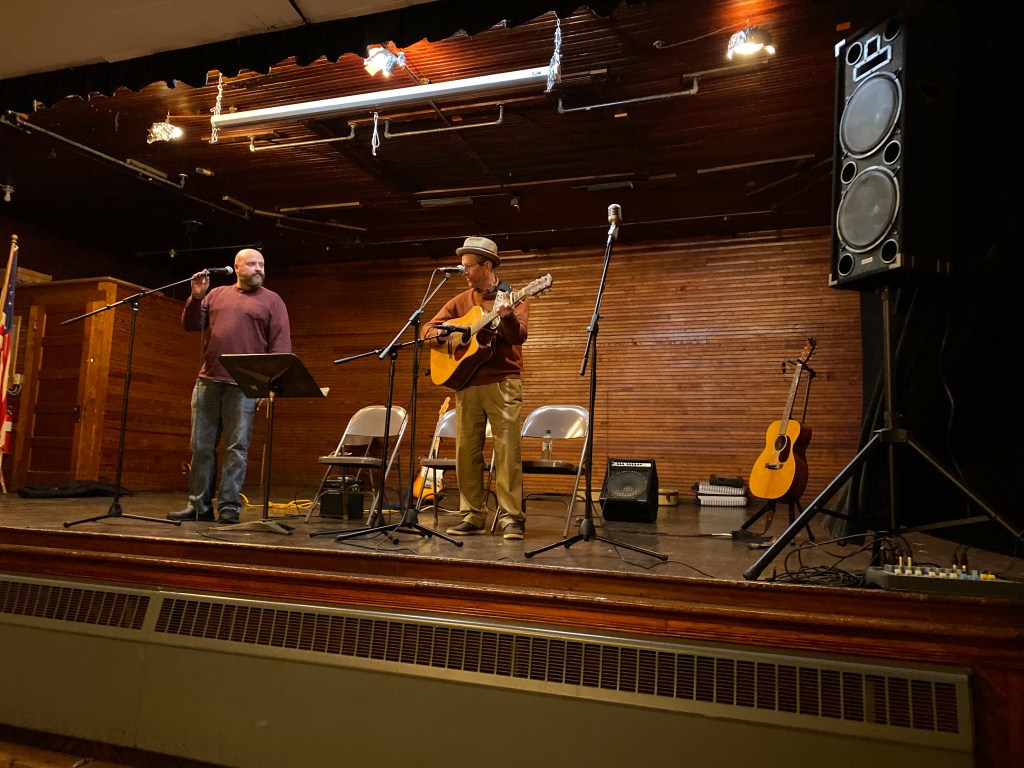
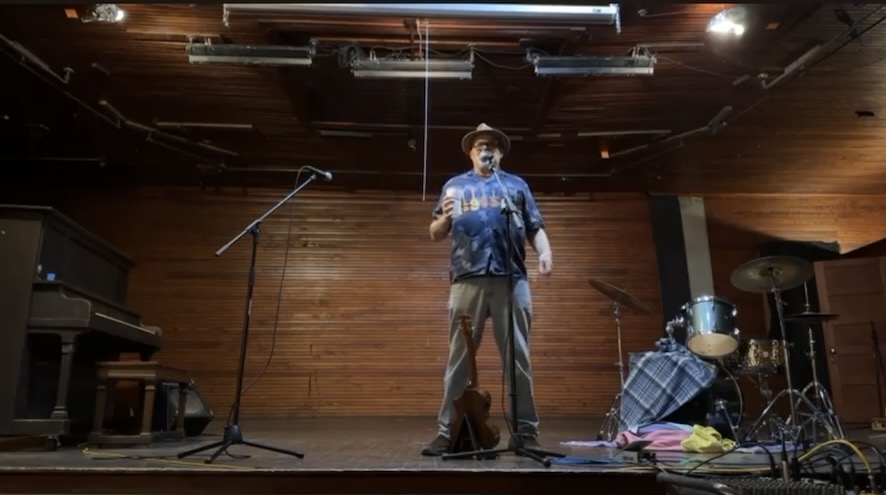
So, out here in the hinterlands, I run an open mic. It is the first Friday of every month. We tried some other days but we landed on Friday. We’ve been going since June 2018. The pandemic got a little intermittent but we powered through. Originally we were lucky if we got a dozen people and the evening would mostly consist of me playing. Now we get 30-40 people and a full night of performers. We have a good amount of really talented writers and poets. We have a group of tween children who come and play instruments, sing, and excerpt musicals. And we have a bunch of excellent singer songwriters who play individually and in groups. I get to play with some of these people, notably House Band, Noyes and the Boyes, and The Solar Plexus.

Noyes And The Boyes
Damon Clift – Didgeridoo
Chrystal’s Angels
Roger and Lenny
Geneva O’Hara

This March we preempted the open mic to present a concert by my ukulele teacher, Charissa Hoffman. She was coming through town up from Nashville on her first tour since graduating Berklee College of Music in Boston. I thought she would be a good fit for the Grange so I arranged to have a concert. We had another young performer, Geneva O’Hara open for her and I backed up Geneva on guitar. We had about 40 people who loved it and it was a great success.

The best thing was having all these people staying at our house. Geneva and her girlfriend, Shelby, and her mom, Tami’s best friend, Maria, all slept scattered throughout the first floor and Charissa and her band, JJ Halpin and Garrett Goodwin, stayed upstairs in the guest rooms. It was the last night of their tour and after a week of couches and floors they deserved something nicer.

Tami made us chili for dinner and egg casseroles and vegan French toast for breakfast. I love having the opportunity to show off our house and Tami’s cooking. It’s great having young people here. It was also great to be able to play with such great musicians. I’m hoping to make it a regular thing.

Charissa Hoffman-Panic Attack On A Tour Bus In Philly

Triple Oh Eighteen

When my mother was growing up, a woman named Edna Conrad used to take care of her during the summers.  Edna remained a fixture in her life and subsequently in ours when we came along.  She was a Quaker from Philadelphia, born in 1898, whom my great grandfather, Earl Barnes met when she was a teenager.  He hired her to help out his family during the summers when they would decamp to his country house in New Hartford, Connecticut.

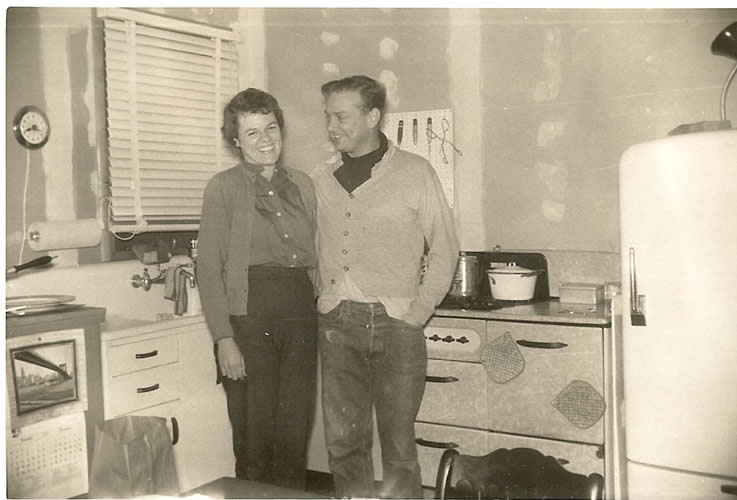
My mother was born in 1928, daughter of Howard Barnes and his wife, Virginia Hood, known as Hoodie.  Hoodie had issues and they divorced by the time my mother was 3.  Edna did the bulk of the mothering of mom after that.  Edna was a teacher at the Little Red Schoolhouse in Greenwich Village.  She lived alone at 8 Bank Street.  My mother lived there as well during her 20’s.  Edna had a little house in Belmont Vermont where she and a number of other teachers had gotten summer places.  I was conceived in that house, or so I’m told.

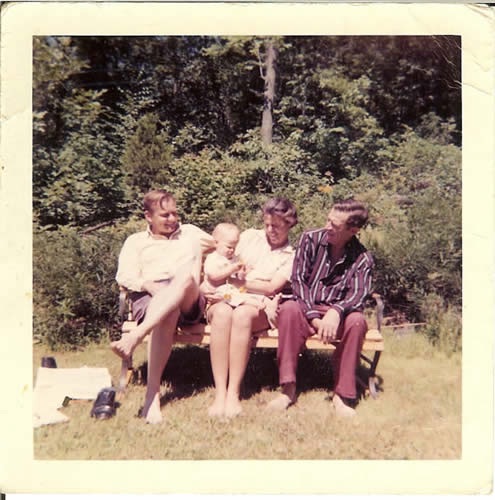
Mom and Dad at Edna’s the morning after…

When my mother was dying of cancer in 1983, Edna came down to Rowayton and took care of her making  macrobiotic meals as was the trend in cancer treatment in the eighties. No shrinking violet, Edna descended upon our household like a whirlwind, cooking, organizing and shuttling between our house, the Irwins’ house, and the hospital. She was in her eighties and my mother was in her fifties.  We boys were in our early twenties except for John who was 13. The prospect of a life without a mother was about to dawn on us, though we had been preparing for this for about two years since we learned of the diagnosis in Fall of 1981.

Edna remained a constancy in our lives through the  years following until her death in 1993. She would always be a destination in Vermont where we could bring friends, girlfriends and fiancés. Tony and I stopped there on our road trip in June 1991 and talked about the James Gleick book, Chaos, which she was reading at the time. After supper we would play Cows and Bulls. It was a kind of memory game that we’d been playing since we were kids any time we’d go to Edna’s. We believed it was responsible for her sharp mind.

When she died she left us Hussey boys $2500 to be divided between us. I had never had such a windfall.

I’d been going to Daddy’s Junky Music Store since 1972 when Fred opened his second store in Norwalk CT. I went into Daddy’s  on Mass Ave with $500 in my pocket.   They had a guitar towards the back which had no label but looked like a badly refinished small Martin. Sure enough it was a 1971 Martin 000-18 with a $500 price tag.

That was my main acoustic all through the nineties on the Boston folk circuit. It didn’t have a pickup and I didn’t have the money to make all the repairs needed to accommodate one. I made do with sound hole pickups and SM57s. Thirty years later and I’ve finally got some money. Lenny tells me about a guy in North Adams who works on Martins, whom he has used before. His name is Steve Sauvé.

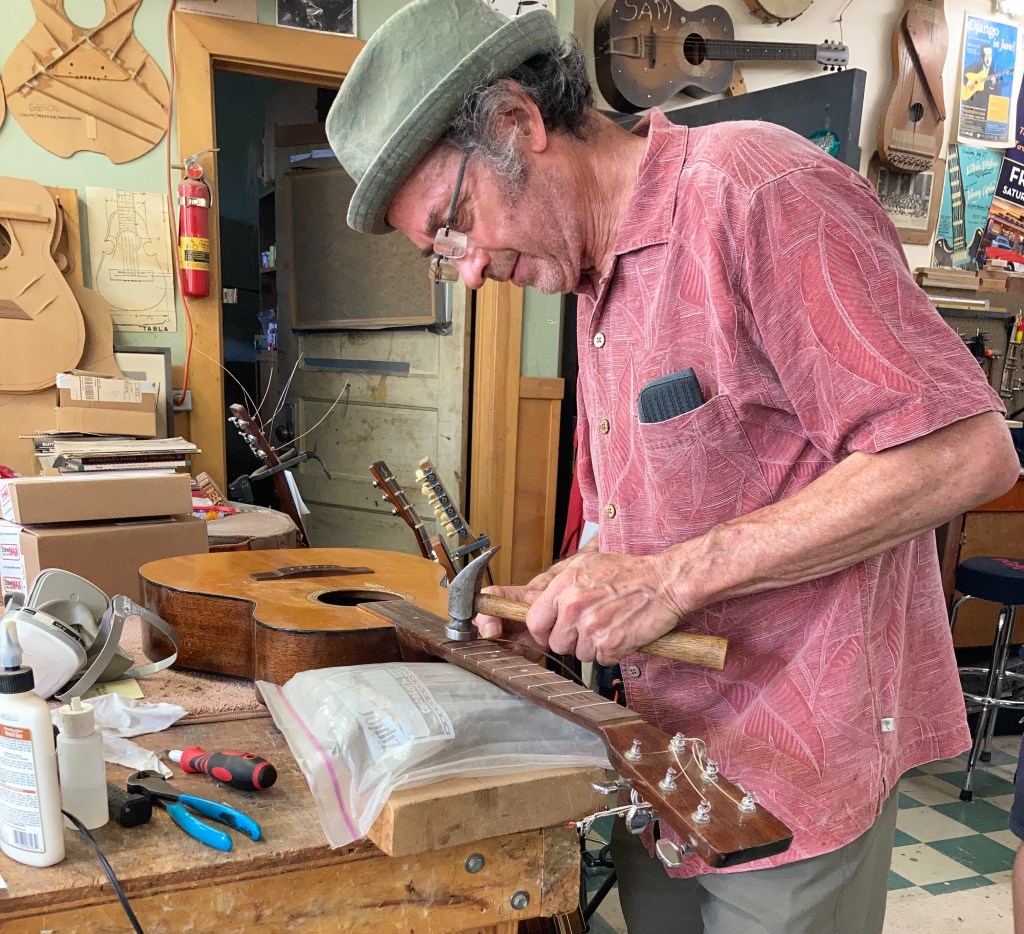
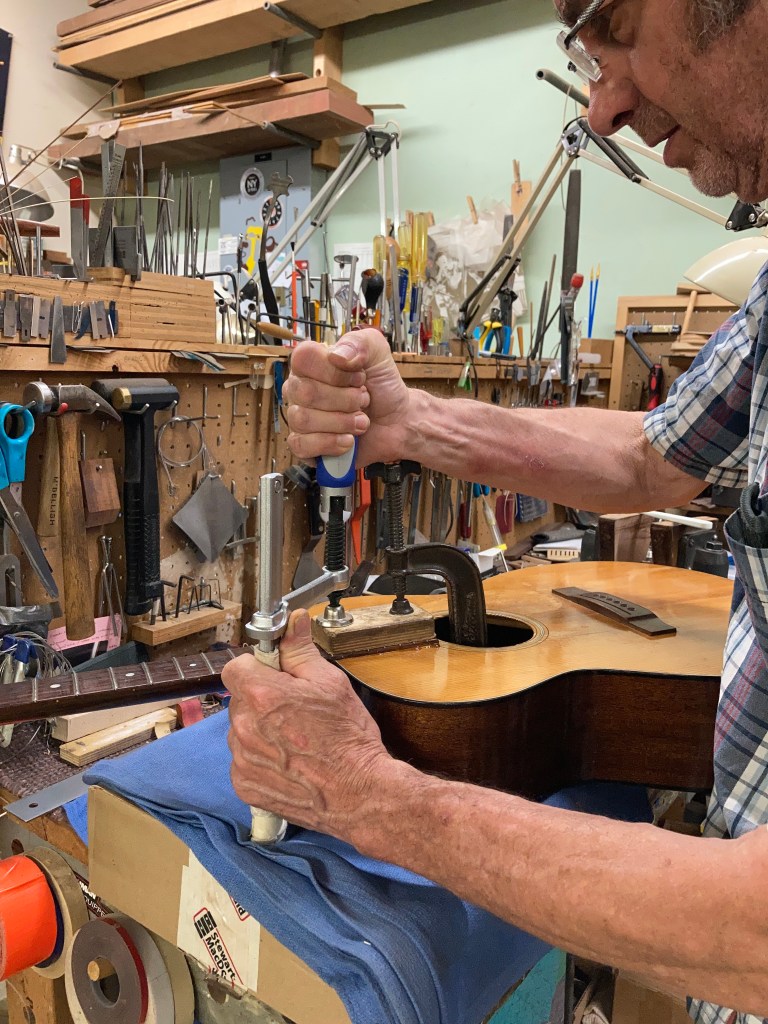
Steve Sauve working on the 000-18 in his shop.

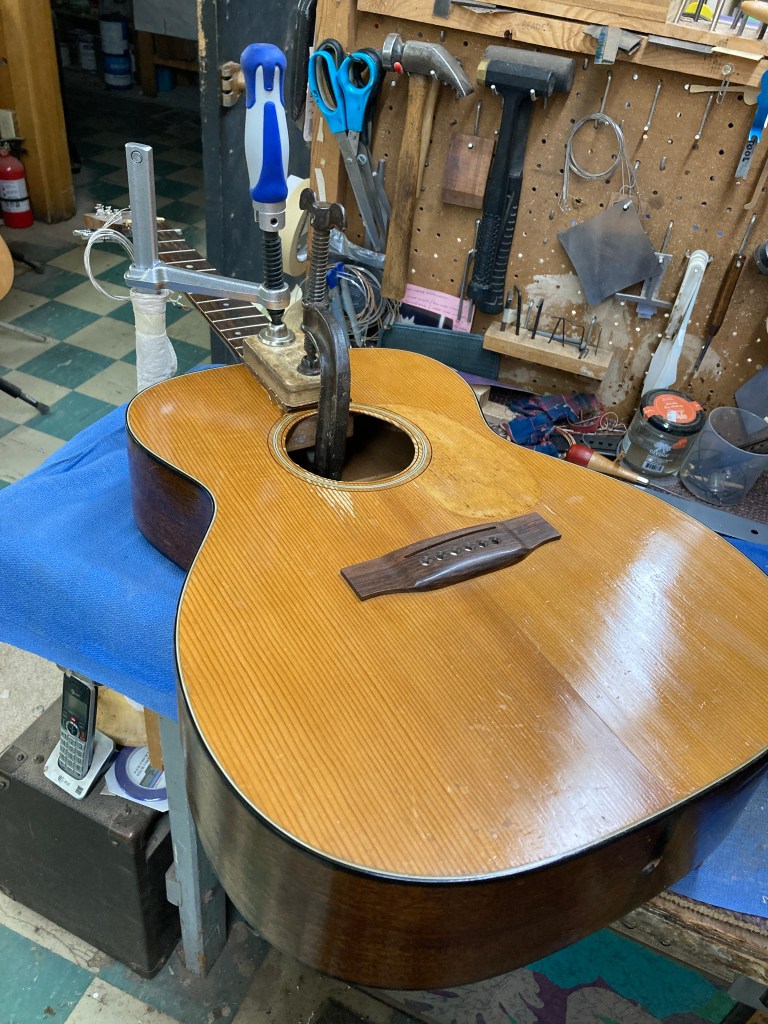
I bring the guitar up to North Adams. On the way, I drop off Neil at the Volvo dealership where he is getting his high end Volvo. Steve’s studio is in an old mill building. There are Covid restrictions so I can’t go in. An assistant comes down to meet me, goes over the guitar with me so I can tell him what I want done. He then takes the guitar and disappears back into the old building and I drive home and wait for 3 months. I realize I never got a receipt and for all I know that could have just been some guy who steals guitars for a living. I finally call him, expecting him to go, “Who? What guitar? A triple-oh-eighteen? Are you sure?” But he does have the guitar and tells me he was just about to start on it. That week, he does and starts sending me pictures of the progress. He takes off the neck and resets it. He replaces the bridge. He puts in the Fishman piezo pickup I have provided him with. I anticipate playing the guitar and having that magical feeling of a properly set up instrument cradled in my arms.

When I finally do go up to pick it up, I am not disappointed. It plays like butter. We have a discussion about what strings to use and how often to change them, something you would think I had worked out after fifty years but, alas, I haven’t. I pay the man and come home to play the guitar I’ve always had and always wanted. It’s beautiful as long as I remember to change the strings.

Website Powered by WordPress.com.

Up ↑